


If you are responsible for people, assets, or reputation, you cannot afford to guess about security. Cameras, alarms, and guards help, but they often react after something has already gone wrong.
K9 security changes that equation. A trained dog and professional handler can detect threats earlier, deter bad actors, and give you a level of coverage that human teams alone simply cannot match.
In this guide, we will explain what K9 security really is, how it works in the field, and what you should expect if you are considering adding a K9 unit to your security program in Minnesota, Wisconsin, Illinois, or across the Midwest.
Why K9 security is different from ordinary security guards
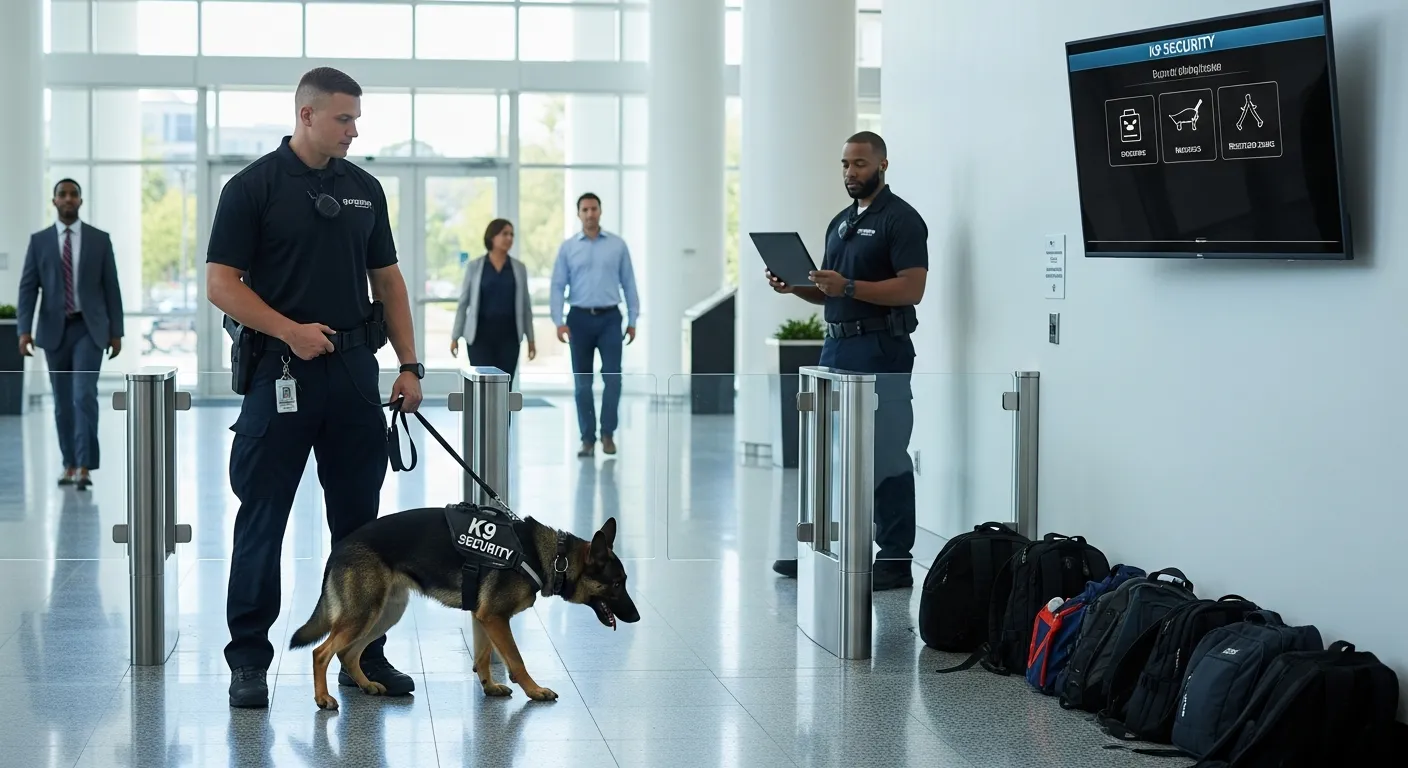
K9 security is the use of professionally trained dogs and handlers to detect threats, control access, and deter criminal or hostile behavior. It is not just “a guard with a dog.“ It is a specialized capability that integrates with your overall security plan.
A well-run K9 program can help you:
- Detect explosives, narcotics, weapons, and other contraband
- Deter stalking, harassment, and workplace violence
- Secure events, warehouses, campuses, and executive movements
- Reduce response times when a threat appears
At Jomsvikings Protection and Security LLC, we treat K9 security as a precision tool, not a prop. Our teams are built around clear objectives, strict training standards, and integration with your existing security and intelligence posture.
What We’ll Cover
- Detection vs. Deterrence
- Deployment Scenarios for K9 Security
- K9 Handler Standards and Training
- How to Prepare Your Organization for K9 Security
- How We Approach K9 Security at Jomsvikings
- K9 Security FAQs
- Next Steps if You Want to Explore K9 Security
Detection vs. Deterrence
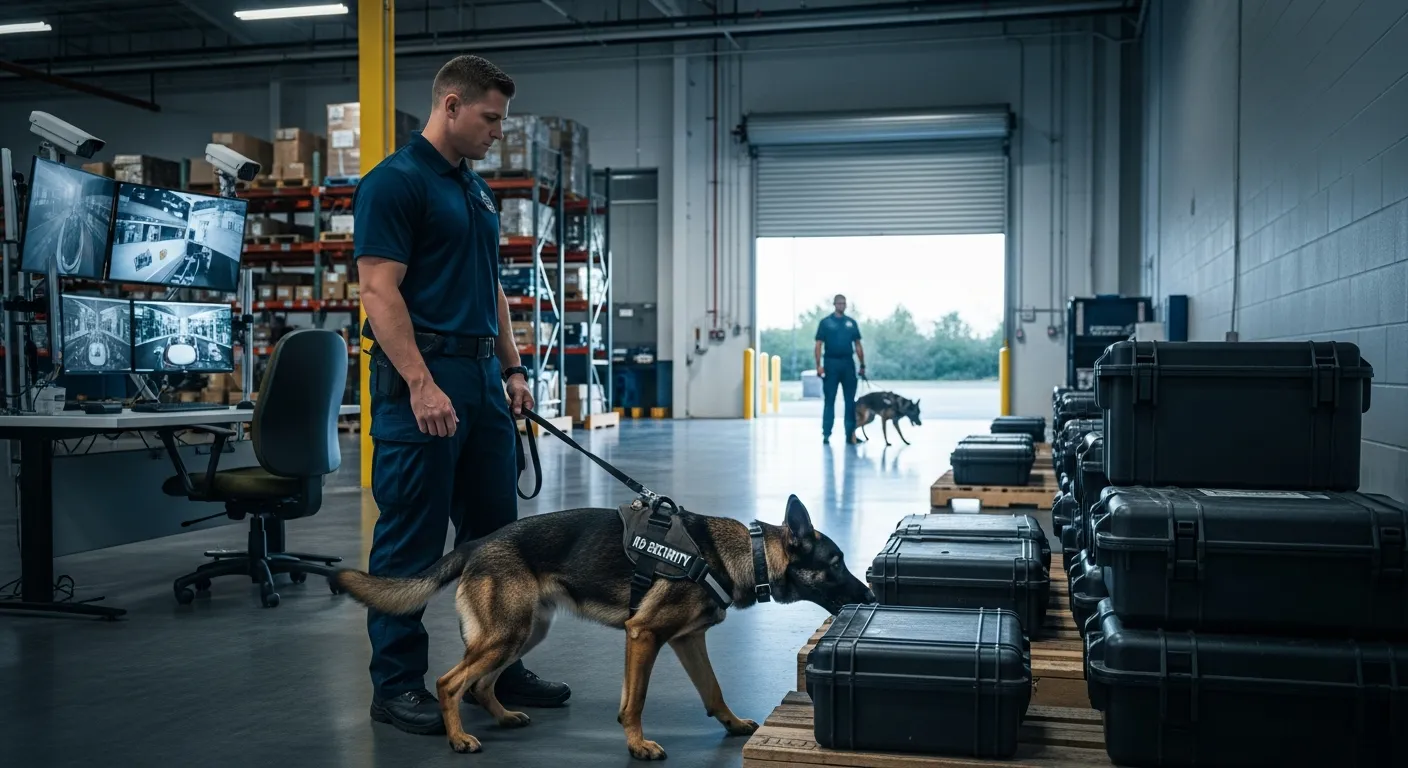
When people ask “What is K9 security,“ they are usually thinking about two things that work together but are very different: detection and deterrence.
What detection really means
Detection is the technical side of K9 security. Dogs are trained to recognize specific odors or cues and alert their handler without creating panic or chaos.
Common detection roles include:
- Explosive detection at corporate events, stadiums, and high profile gatherings
- Narcotics detection in warehouses, corporate campuses, or residential properties
- Contraband detection in secure facilities or logistics hubs
A good detection dog does not just “sniff around.“ It works on a structured search pattern, covers large areas faster than human teams, and gives clear, conditioned responses that the handler can interpret under pressure.
This is where professional K9 security pulls away from DIY or in house solutions. Real detection training requires:
- Repetition in real environments
- Exposure to a wide range of target odors and distractions
- Ongoing certification and quality control
Without that rigor, a dog is a liability, not an asset.
How deterrence protects you before something happens
Deterrence is the psychological effect of a visible K9 presence. The moment a potential offender sees a disciplined dog and handler, the risk calculation changes.
In our experience, K9 units can:
- Reduce attempts at theft and vandalism in warehouses and yards
- Discourage stalkers or harassers from approaching executives or residences
- Calm crowds when positioned correctly with clear communication
What this really means is that you are preventing a percentage of incidents from ever starting. That saves you time, money, and reputation.
Our K9 teams are integrated with our broader site security services and surveillance services so detection and deterrence work together instead of in isolation.
Deployment Scenarios for K9 Security
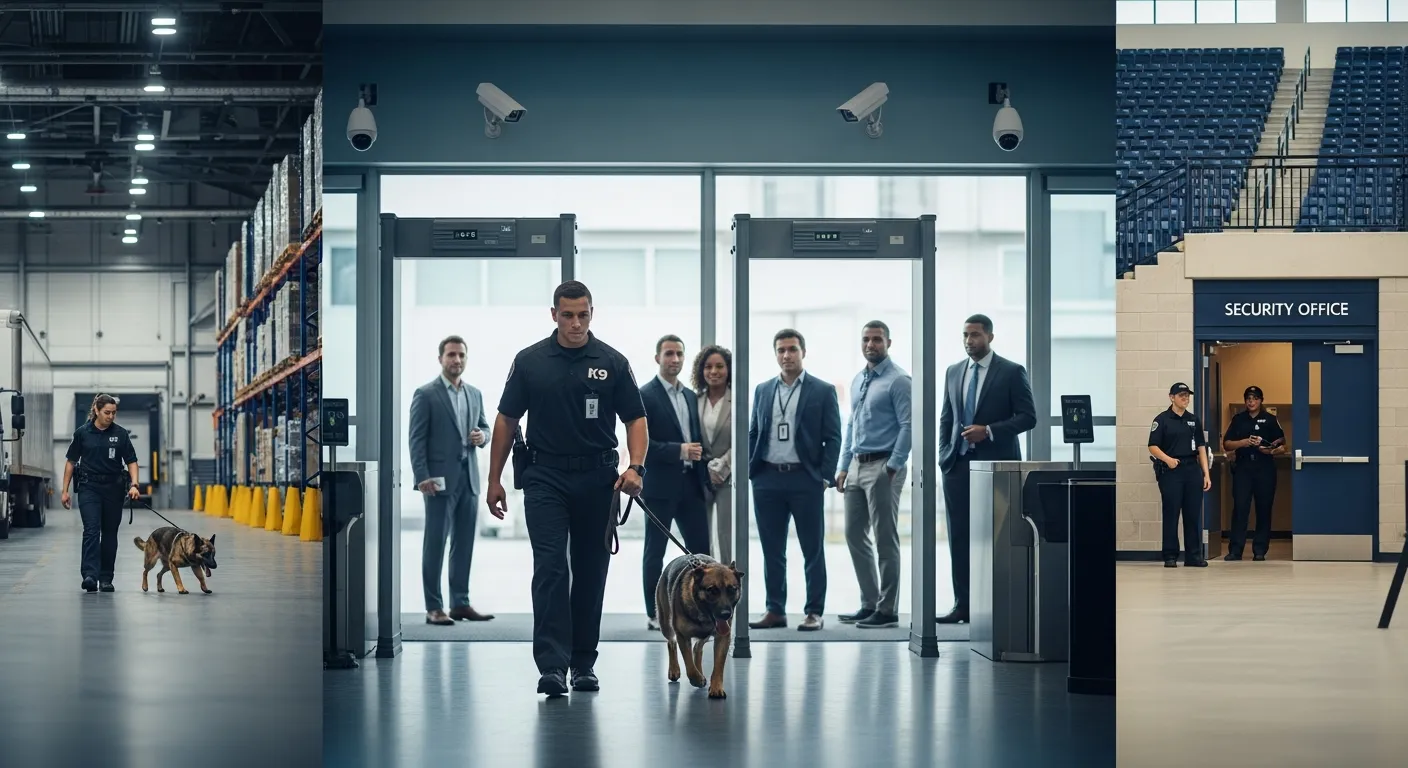
K9 security is not one size fits all. Where and how we deploy a dog team depends on your threats, environment, and operations.
Corporate events and executive gatherings
For executive offsites, shareholder meetings, product launches, or media events, K9 teams are often part of a layered plan that can also include close protection services and intelligence support.
Typical uses:
- Pre event sweeps of venues, stages, parking areas, and green rooms
- Screening of high risk deliveries or VIP access points
- Visible presence at entrances to discourage weapons or contraband
We have seen K9 presence dramatically reduce security interventions at events because problems are stopped at the perimeter.
Warehouses, logistics hubs, and industrial sites
In warehouses and yards, losses often come from insiders or trusted contractors. Cameras alone rarely solve that problem.
K9 teams can be deployed to:
- Conduct random or scheduled sweeps of storage areas and vehicles
- Support gate and access control operations
- Provide roving patrols during high risk windows such as nights and weekends
For organizations operating in high traffic areas like Minneapolis, Milwaukee, or Chicago, a K9 unit can be built into a broader program supported by our regional teams at security company Minneapolis, security company Milwaukee, and security company Chicago.
Public venues and campuses
Stadiums, arenas, schools, and large campuses face a mix of crowd management, potential weapons, and targeted threats.
In these environments, we focus on:
- Pre event or pre opening sweeps of common areas and back of house spaces
- Strategic placement of K9 teams at key chokepoints
- Coordination with local law enforcement and your in house security
For education clients, K9 is often part of a broader school safety and workplace violence prevention strategy instead of a stand alone tactic.
K9 Handler Standards and Training
The quality of a K9 program lives or dies with the handler. A good dog in the hands of an untrained or careless operator is a serious risk.
At Jomsvikings, we hold our handlers to standards shaped by military, law enforcement, and private sector best practices.
Core skills every professional K9 handler must have
Our view is that a K9 handler must be able to:
- Control the dog with calm, consistent handling under stress
- Read subtle behavioral cues that signal a change in environment or threat
- Communicate clearly with your leadership and other security elements
- Document searches, alerts, and training for legal and compliance needs
We prioritize candidates with real world security or public safety backgrounds, then build their skills through structured courses like our training programs and specialized security officer training courses Minneapolis.
Ongoing training and certification
K9 work is not something you “learn once and keep forever.“ Odors change, environments change, and legal expectations certainly change.
Our internal standards include:
- Regular scenario based training in environments similar to your sites
- Periodic third party evaluations and certifications where appropriate
- Continuous improvement cycles tied to real incidents and case studies in executive protection
We build K9 into a career track, not a side assignment. That is one of the key differences between a veteran led firm like ours and commodity guard services trying to bolt a dog onto a basic patrol contract.
How to Prepare Your Organization for K9 Security
When you work with us on K9 security, we do not just show up with a dog and figure it out on the fly. Good preparation keeps operations smooth and reduces disruptions for your staff, guests, or customers.
What we need from you before deployment
During planning, we typically ask for:
- A clear description of your concerns or recent incidents
- Floor plans, site maps, or at least detailed layouts
- Schedules for events, shifts, or deliveries
- Points of contact for security, facilities, and leadership
We may also integrate K9 plans with your intelligence services subscription or broader consulting services if you are running a larger security program.
What your people should expect
Staff and guests do not need to be “trained” to work around K9 teams, but they do need clear expectations.
As part of client prep, we can help you:
- Craft simple internal communications so employees understand why the K9 is on site
- Set rules around approaching or interacting with the dog
- Coordinate any access control or search procedures that affect daily operations
Trying to build your own K9 solution or using unproven vendors often fails at this stage. Miscommunication, inconsistent procedures, and unclear authority create friction and complaints. Our job is to make security feel professional and predictable, not chaotic.
How We Approach K9 Security at Jomsvikings
We built Jomsvikings Protection and Security LLC as a veteran led firm that takes threat management personally. For us, K9 security is part of a larger ecosystem of executive protection, site security, and training across the Upper Midwest.
Integrated, intelligence driven planning
K9 teams are most effective when they are guided by solid intelligence. That is why we often pair K9 deployments with our analytical and intelligence services. This lets us:
- Focus searches on high risk areas and time windows
- Adapt to evolving threats such as protests, online chatter, or insider risks
- Support your legal and HR teams with documented risk assessments
Our broader services include executive protection, armed and unarmed security, and specialized training, which means we can design a security posture where K9 is used precisely where it adds the most value.
Training, discipline, and continuous improvement
Our leadership has more than two decades of combined operational experience in military, law enforcement, and private security roles. That background shapes how we select dogs, train handlers, and audit our own performance.
We invest heavily in professional development through programs like Minneapolis metro security training for urban challenges and broader 7 benefits of continuous improvement in the security industry, because stagnant skills are a liability in this work.
The result is a K9 capability that fits naturally into complex security operations, rather than a superficial add on created for marketing.
K9 security FAQs
Is K9 security safe around employees and guests?
Yes, when it is done correctly. Our dogs are selected and trained for stability and control in public environments. They do not roam free. They work under handler direction, on leash or in tightly managed conditions. Our prep work with you includes guidance on how your staff should interact with the dog team.
Do I need K9 security full time or just for specific events?
Most clients start with targeted deployments for specific events, investigations, or problem locations. From there, we may recommend periodic sweeps or a regular presence if your risk level justifies it. During a consultation, we will walk through your sites and threat profile to decide what makes sense.
Can K9 units replace cameras or regular guards?
No, and they should not. K9 security is a force multiplier, not a full replacement. Dogs cannot monitor every camera feed or manage access control on their own. The most effective programs combine K9 units with physical security, policy, and technology supports.
What does the process look like if we move forward?
Typically, we start with a security consultation and site review. From there, we design a K9 deployment plan with clear objectives, schedules, and protocols. In many cases, K9 is integrated with our site security services and executive or corporate protection elements.
Do you provide K9 security outside Minnesota?
Our primary footprint is Minnesota and Wisconsin with extended coverage into Illinois and other Midwest metro areas. Through our regional presence and our partners, we can often support multi site or traveling operations that include cities like Minneapolis, Milwaukee, Chicago, Rochester, and surrounding regions.
Next Steps if You Want to Explore K9 Security
K9 security is one of the few tools that can both find hidden threats and convince bad actors not to try in the first place. When it is built and led by professionals, it gives executives, facility leaders, and corporations a level of confidence that cameras and basic guards cannot match.
If you are responsible for a high value site, a growing workforce, or high profile individuals, it is worth a serious conversation about where a K9 unit fits into your security strategy. We can walk you through options, explain what is realistic for your budget and risk profile, and design a deployment that aligns with your broader protection goals.
For a deeper look at how we think about risk and protection around people and assets, you can also explore our work in ensuring a secure environment for executives and keeping your employees secure, confident, and productive. When you are ready, our veteran led team is prepared to help you plan your next move.
Key Takeaways
- K9 security combines professionally trained dogs and handlers to detect threats, control access, and deter criminal behavior as an integrated part of your overall security plan.
- Detection-focused K9 security teams use structured search patterns and rigorous, ongoing training to find explosives, narcotics, weapons, and other contraband faster and more reliably than human teams alone.
- Visible K9 units provide powerful deterrence by changing offenders’ risk calculations, reducing incidents such as theft, vandalism, stalking, and workplace violence before they occur.
- Effective K9 security depends on highly trained handlers who can control the dog under stress, interpret subtle behavioral cues, communicate with leadership, and maintain detailed documentation for legal and compliance needs.
- A successful K9 deployment starts with solid client preparation—including clear objectives, site layouts, schedules, and communication plans—so operations run smoothly with minimal disruption to staff and guests.
- At Jomsvikings Protection and Security LLC, K9 security is part of an intelligence-driven, veteran-led security ecosystem that covers executive protection, site security, and training across Minnesota, Wisconsin, Illinois, and the broader Midwest.
K9 Security FAQs
What is K9 security and how does it work?
K9 security is the use of professionally trained dogs and handlers to detect threats, control access, and deter criminal or hostile behavior. Dogs use their advanced sense of smell and presence to locate explosives, narcotics, or weapons and discourage bad actors, working as part of a wider security strategy.
What are the main benefits of adding K9 security to an existing security program?
K9 security enhances both detection and deterrence. Properly trained dogs can locate explosives, narcotics, and other contraband faster than human teams, while their visible presence reduces theft, vandalism, stalking, and workplace violence. Integrated with guards, cameras, and intelligence, K9 units shorten response times and prevent many incidents from starting.
Where is K9 security most commonly used in the Midwest?
In the Midwest, K9 security is frequently deployed at corporate events, warehouses, logistics hubs, industrial sites, stadiums, campuses, and executive residences. Cities like Minneapolis, Milwaukee, and Chicago often use K9 units for pre-event sweeps, access screening, roving patrols, and support to broader executive protection or site security programs.
How much does K9 security typically cost?
K9 security pricing varies based on location, duration, risk level, and whether you need detection, deterrence, or both. Costs are usually billed hourly or per deployment, with specialized explosive or narcotics detection teams priced higher. Many clients start with short-term or event-based deployments before moving to recurring schedules if justified by risk.
What types of dogs are used in K9 security services?
K9 security programs typically use breeds with high drive, stability, and trainability, such as German Shepherds, Belgian Malinois, Labrador Retrievers, and sometimes Dutch Shepherds. Selection focuses more on temperament, health, and work ethic than on breed alone, followed by rigorous training to ensure safe, controlled performance in public environments.
How do I choose a reliable K9 security provider?
Look for a provider that treats K9 security as a specialized discipline, not a marketing add-on. Key indicators include formal handler training, ongoing certifications, scenario-based drills, documented procedures, integration with broader security services, and clear planning with your leadership. Ask for references, training standards, and example deployment plans before committing.

- What Is K9 Security? A Practical Guide For Executives And Facility Leaders - December 12, 2025
- What Are the Different Types of Security for an Event? - November 7, 2025
- Case Studies in Executive Protection: Real-Life Scenarios and Lessons - October 15, 2023


